
The 74-Day Sperm Cycle Explained
Almost every piece of fertility advice comes with an invisible condition attached: give it about three months. That is not vagueness, it is biology. Here is the production timeline that governs how quickly your sperm can actually change.
If you have read anything about improving sperm health, you have met the three-month rule: stop smoking, cool down, eat better, then wait about three months before testing again. That number is not a hedge. It comes from the measured length of human sperm production.
Key takeaways
- Spermatogenesis in humans takes approximately 74 days.
- Sperm then spend roughly two more weeks maturing in the epididymis.
- Sperm are cells; semen is the fluid carrying them, mostly from the seminal vesicles and prostate.
- Production is continuous and staggered, so millions of sperm are released daily.
- Any lifestyle change needs a full cycle before a repeat test can show its effect.
Sperm production is a continuous pipeline
Sperm are made in the seminiferous tubules of the testes, in a process called spermatogenesis. It begins with stem cells that divide, then differentiate through several stages before becoming recognisable sperm. Crucially, this is not a batch process. Different sections of the tubules are at different stages simultaneously, which is why a healthy man produces on the order of 150 to 275 million sperm every day rather than one consignment every few months.
That staggered design has an important implication. At any moment, your testes contain sperm at every stage of development, from cells that started weeks ago to those about to be released. Whatever affects your body today reaches all of them, but the damage or benefit shows up in the ejaculate at different times.
The plumbing: where sperm are made and where semen comes from
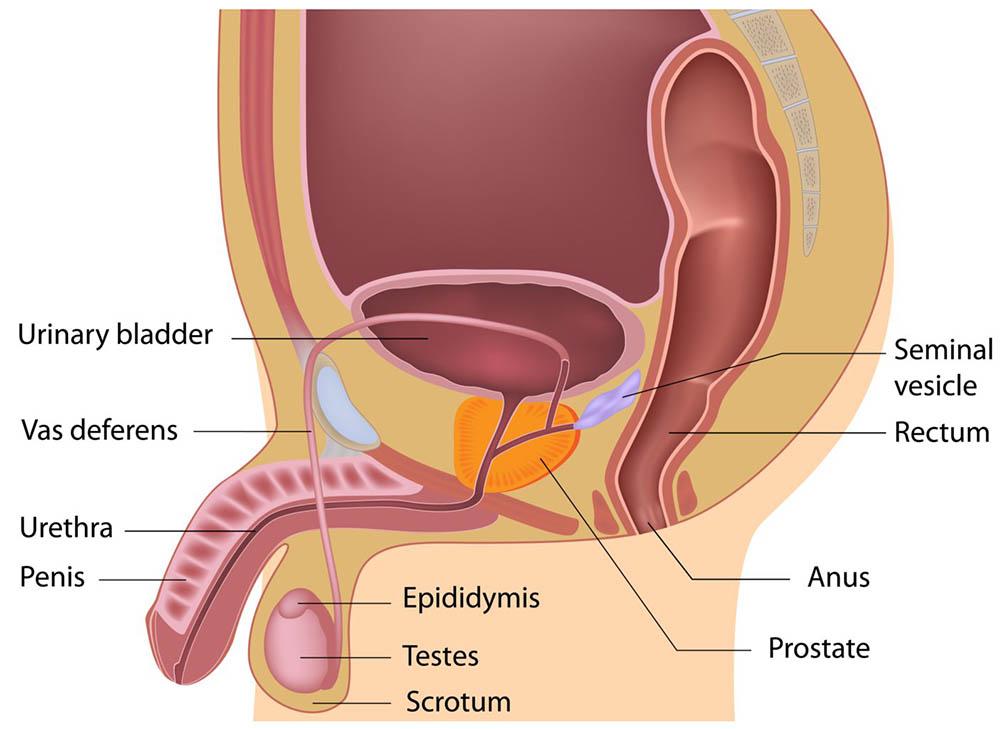
Before the timeline makes sense, it helps to see the route. Sperm are made in one place, matured in another, and mixed with fluid from two more before anything leaves the body. Each of those stations does a different job, and problems at each show up differently on a semen analysis.
Sperm and semen are not the same thing
This distinction trips up almost everyone reading a report for the first time. Sperm are the cells. Semen is the fluid that carries them, and sperm make up only a very small fraction of it, on the order of a few per cent of the total volume. The rest is secretions from the accessory glands.
That is why a report gives you both a concentration (sperm per millilitre) and a volume (millilitres of semen). They measure two different systems that can fail independently. A man can produce plenty of sperm but very little fluid, or plenty of fluid containing almost no sperm, and the causes are entirely different.
Seminiferous tubules versus seminal vesicles
The names are similar enough to be genuinely confusing, and they do completely unrelated jobs.
| Seminiferous tubules | Seminal vesicles | |
|---|---|---|
| Where | Coiled inside each testis | Paired glands behind the bladder |
| What they do | Produce sperm cells | Produce seminal fluid |
| Output | Sperm, roughly 2–5% of semen | Around 60–70% of semen volume |
| Contains | Germ cells and Sertoli cells | Fructose, prostaglandins, proteins |
| Problem shows as | Low count, poor motility or morphology | Low volume, abnormal pH |
The seminal vesicles supply the fructose that fuels sperm movement, which is why a very low fructose reading can point to a blockage of these ducts rather than a production problem in the testes. The prostate adds most of the remainder, a thinner alkaline fluid that helps neutralise vaginal acidity and contains the enzymes responsible for liquefying semen after ejaculation.
The vas deferens: the connecting road
The vas deferens is the muscular tube carrying mature sperm from the epididymis up and around to join the ducts from the seminal vesicles just before the urethra. It is the structure cut during a vasectomy, which is precisely why that procedure stops sperm reaching the ejaculate while leaving semen volume essentially unchanged: the glands producing the fluid sit downstream of the cut.
Blockage of the vas deferens, whether surgical, congenital or from scarring after infection, produces obstructive azoospermia: no sperm in the sample despite normal production inside the testes. That is a very different problem from failure of production itself, and it is one reason a low or absent count always warrants proper assessment rather than assumption.
Where the number 74 comes from
The figure traces to classic work by Heller and Clermont in the 1960s, who injected a radioactive label and tracked its progress through testicular biopsies. They concluded that spermatogenesis spans 4.6 cycles of the seminiferous epithelium, each about 16 days, adding up to roughly 74 days.
You will sometimes see 64 days quoted instead. That shorter figure omits the early proliferation of spermatogonia, the dividing stem cells at the very start of the process. A 2008 review argued that, until better data exists, the duration of human spermatogenesis should be cited as approximately 74 days. More recent work suggests genuine individual variation, with estimates ranging from around 42 to 76 days.
The sperm in today's sample began forming before you made any of the changes you are hoping to see reflected in it.
The extra two weeks nobody mentions
Finishing production is not the same as being ready. Sperm leaving the testes cannot yet swim forward effectively. They travel into the epididymis, a tightly coiled tube behind the testis, where over roughly ten to fourteen days they undergo biochemical changes to their membranes and gain progressive motility.
Add that transit to production and the full journey from stem cell to a sperm capable of fertilising an egg is closer to two and a half to three months. That is the real number behind the advice.
Why the timeline matters so much
Three practical consequences follow.
- Improvements are delayed, not absent. Quitting smoking or losing weight will not change next week's sample. It changes the sample taken after a full cycle has turned over.
- Setbacks are also delayed. A high fever, a bout of illness, or weeks of intense heat exposure can show up in an analysis two months later, long after you have forgotten the cause. This is one reason single results are unreliable.
- Consistency beats intensity. Because the pipeline is always running, sustained habits matter far more than a short burst of effort before a test.
When to re-test
If you have made genuine changes, testing after two to three months gives the new cohort of sperm time to reach the ejaculate. Testing sooner mostly measures your old habits. It is also worth keeping the abstinence period consistent between tests, usually two to five days, since that alone can shift volume and motility enough to confuse a comparison.
Once you have a second result, our parameter check lets you compare each value against the WHO 2021 reference limits, so you can see specifically which parameters moved.
This article is educational, not medical advice. It is not a diagnosis and not a substitute for care from a qualified doctor. Sperm parameters vary between samples, so always discuss your own results with a licensed clinician.
Sources
- Heller CG, Clermont Y. Kinetics of the germinal epithelium in man. Recent Progress in Hormone Research. 1964;20:545–575.
- Amann RP. The cycle of the seminiferous epithelium in humans: a need to revisit? Journal of Andrology. 2008;29(5):469–487.
- Neto FTL, Bach PV, Najari BB, et al. Spermatogenesis in humans and its affecting factors. Seminars in Cell & Developmental Biology. 2016;59:10–26.
- World Health Organization. WHO laboratory manual for the examination and processing of human semen, 6th edition. Geneva: WHO; 2021.